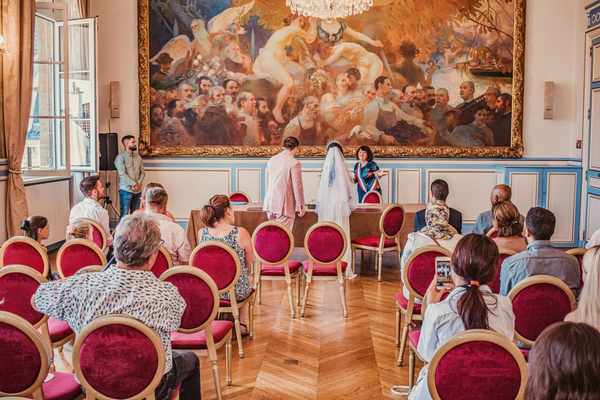
A civil wedding ceremony is often described as the simple alternative to a traditional wedding, but simple does not have to mean impersonal. You might exchange vows in a courthouse office with one witness, or gather family in a garden for a ceremony led by an authorized officiant. Both can be meaningful. The key is knowing which parts make the marriage legally valid and which moments are yours to shape.
What Is a Civil Wedding Ceremony?
A civil ceremony is a nonreligious marriage ceremony conducted by someone legally authorized to officiate. Depending on the state, that person might be a judge, justice of the peace, city clerk, or another recognized officiant. Some take place in government buildings; others happen at private venues, homes, or outdoor locations.
A courthouse wedding ceremony is one kind of civil wedding, not the definition of every civil wedding. Government-office appointments are often brief and may offer limited flexibility. A private civil ceremony usually provides more room for music, readings, and a personalized script, subject to the officiant’s requirements.
The Legal Elements You Need to Confirm
There is no single national script for a legal wedding ceremony in the United States. Marriage laws vary by state, and local offices set practical rules for appointments and paperwork. Before writing vows or reserving a venue, verify the following with the clerk or vital records authority where the marriage will occur.
Marriage License and Timing
Most couples must obtain a marriage license before the ceremony. Check identification requirements, fees, waiting periods, expiration dates, and whether your license is valid at the chosen location. For example, Massachusetts generally has a three-day waiting period and a license valid for 60 days, while California licenses are generally valid for 90 days. These examples illustrate why checking your own jurisdiction matters.
Authorized Officiant, Consent, and Witnesses
Your officiant must be legally permitted to solemnize the marriage under applicable law. The couple must express the agreement to marry in a manner that satisfies those requirements, but a particular poetic vow is not universally mandatory. Witness rules differ too: California’s public marriage license requires at least one witness, while its confidential marriage license does not. Never assume a friend can officiate or that witnesses are optional without checking.
Signing and Returning the Paperwork
Ask who signs the license, when it must be returned, and who is responsible for filing it. The officiant commonly handles submission, but the precise process depends on the jurisdiction. A certified marriage certificate is a separate record you may need to request afterward for name changes, benefits, or other official purposes.
A Typical Civil Ceremony Order
There is no universal civil ceremony order, but a short, welcoming structure often works well. It can be adjusted for a five-minute office appointment or an intimate gathering lasting twenty minutes.
Welcome and Opening Words
The officiant welcomes everyone and briefly explains why the couple has gathered. In a courthouse setting, this may be just a sentence or two. At a private venue, you can add a favorite story or a reflection on partnership.
Declaration of Intent and Vows
The officiant asks each partner to affirm their intention to marry, using language suitable for the jurisdiction. Couples may then exchange personal civil wedding vows. Keep these distinct in your planning: personal promises add emotion, while the legal declaration must satisfy the relevant rules.
Rings, Pronouncement, and Closing
Rings are customary rather than a universal legal requirement. If you exchange them, add a short line about what they represent. The officiant completes the legally appropriate pronouncement, then invites a kiss, an embrace, or simply a round of applause. Any signing takes place according to local procedure, not necessarily in front of guests.
How to Make the Ceremony Feel Like Yours
Start by asking your officiant what cannot change. Then build around that fixed core. For a private ceremony, consider inviting one person to read a few lines from a meaningful book, walking in together, choosing an instrumental song, or ending with a shared family blessing that reflects your values without turning the legal ceremony into a religious service.
For personal vows, aim for a minute or less each. Mention one real quality you admire, one memory that shows it, and two promises you intend to keep. A vow like “I promise to make room for your plans, even when ours change” is often more memorable than a string of grand declarations.
Courthouse Appointment or Private Civil Ceremony?
Choose an office ceremony if convenience, cost control, or privacy is the priority. Ask about booking, arrival time, identification, guest limits, witness arrangements, and any ceremony fee. For example, New York City’s clerk-office ceremonies require appointments and a witness; walk-ins are not offered. Your city may use a different system. A courthouse wedding planning guide can help organize the details.
A Practical Example: Personal Without Complicated
Imagine two partners planning a Saturday garden ceremony for twelve guests. They obtain the correct license, confirm their officiant’s authority, and check witness rules first. Then they plan a fifteen-minute program: a warm welcome, a sibling’s reading, legal declaration of intent, two short personal vows, rings, and a closing pronouncement. Their friend handles music afterward rather than interrupting the legal portion.
Questions to Settle Before the Wedding Day
Confirm your appointment or officiant booking in writing. Check the license’s dates, the required identification, who must attend, and the return procedure. Share the final script with your officiant and bring any approved readings or music cues. A marriage license checklist and a guide to writing wedding vows can make the preparation easier, especially when the legal details and creative choices are being handled by different people.
Frequently Asked Questions
How long does a civil wedding ceremony take?
A brief courthouse appointment may involve only a few minutes of ceremony, while a personalized gathering might take fifteen to thirty minutes. Allow extra time for check-in, security, photos, and paperwork where applicable.
Can we write our own civil wedding vows?
Usually, yes, especially with a private officiant. However, your personal promises cannot replace any legally necessary declarations. Ask the officiant to approve the final wording and sequence.
Do we need rings or guests?
Rings are not universally required. Guest and witness requirements are separate questions: some places require witnesses even if you want a nearly private ceremony. Check the rules for your particular license and location.
Is a civil ceremony legally binding?
Yes, when the couple meets the applicable marriage requirements, the ceremony is performed by an authorized person, and the required documentation is properly completed and filed. A romantic setting or elaborate vows alone do not establish legal validity.
A Ceremony That Fits Your Relationship
The best civil wedding ceremony makes the legal essentials feel clear rather than intimidating. Once you know the license rules, who can officiate, and what must be said or signed, you can spend your attention on the parts guests will remember: the words, the people, and the promises you actually mean.