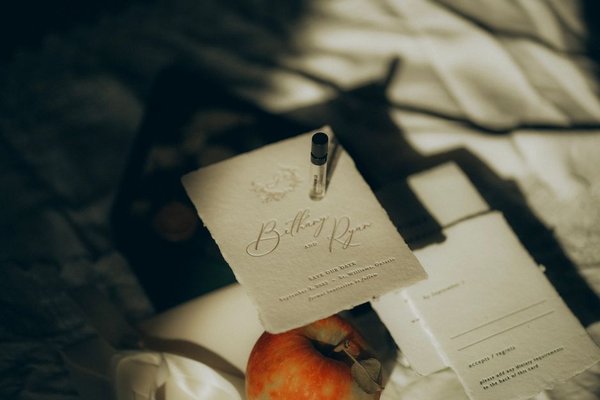
Good wedding invitation wording sounds like the couple while giving guests everything they need to attend. A traditional ceremony might call for a graceful, formal request; a backyard celebration might sound better with a friendly note. Neither approach is automatically more correct.
These wedding invitation examples offer ready-to-adapt language for different celebrations. Replace the names and locations, then check that each invitation accurately describes what its recipient is invited to attend. Clarity matters as much as style.
What Every Wedding Invitation Should Include
Guests need to know who is inviting them, who is getting married, the type of celebration, its date and start time, the venue, and how to respond. If the reception is elsewhere, give its location and timing too. A poetic opening is lovely, but essential information should never be hard to find.
Most invitations follow a simple sequence: host line, couple’s names, request to attend, ceremony details, reception details, and RSVP instructions. A wedding invitation checklist is useful before printing.
Wedding Invitation Wording Examples for Different Styles
Formal and Traditional
Formal wedding invite text typically uses full names and spelled-out dates. Traditionally, “the honour of your presence” is associated with a ceremony in a place of worship; “the pleasure of your company” is common elsewhere. These are conventions, not obligations.
Example: “Mr. and Mrs. Daniel Morgan request the pleasure of your company at the marriage of their daughter, Charlotte Morgan, to James Bennett, on Saturday, the twelfth of June, two thousand twenty-seven, at four o’clock in the afternoon, The Garden Hall, Portland, Oregon. Reception to follow.”
When the couple is hosting, begin with their names instead. Formality does not require a fictional parental host line.
Casual and Friendly
For a relaxed wedding, everyday language often feels more welcoming than elaborate phrasing.
Example: “We’re getting married! Come celebrate with Maya and Leo on Saturday, June 12, 2027, at 4 p.m. at The Garden Hall in Portland. Stay for dinner and dancing. Please reply by May 12.”
The cheerful tone works well for intimate parties, garden weddings, or digital invitations. Keep the practical details just as clear as on a formal card.
Modern and Minimalist
Modern invitation wording ideas use simple lines, few titles, and equal prominence for both partners.
Example: “Together with their families, Avery Chen and Jordan Ellis invite you to celebrate their marriage. Saturday, June 12, 2027, at 4 p.m. The Garden Hall, Portland, Oregon. Dinner and celebration to follow.”
“Together with their families” can acknowledge everyone’s support without suggesting one household alone is hosting or paying.
Religious Ceremonies
Religious wording may name the ceremony and include a short expression of faith. Choose words that reflect the couple’s beliefs and the customs of their community.
Christian example: “With gratitude for God’s blessings, Olivia and Samuel invite you to witness their marriage on Saturday, June 12, 2027, at four o’clock, Grace Chapel, Portland. Reception to follow.”
Nikah example: “With gratitude to Allah, the families of Amina and Yusuf request the pleasure of your company at their nikah on Saturday, June 12, 2027, at 4 p.m., Community Hall, Portland. Dinner to follow.”
If guests should know about dress expectations or particular ceremony arrangements, explain them respectfully on a details card rather than assuming everyone understands the traditions.
Reception-Only and Intimate Celebrations
Someone invited to the party but not the ceremony should receive wording that explicitly says “reception.” Avoid phrases that imply they will witness the marriage.
Example: “We married in a private ceremony and would love to celebrate with you! Please join Nadia and Ben for a wedding reception on Saturday, June 12, 2027, at 6 p.m., The Garden Hall, Portland. Dinner and dancing to follow.”
This approach is especially considerate when the ceremony includes only close family but the reception welcomes a larger circle.
Who Should Appear on the Host Line?
Parents can be named first when they are hosting, but couples may issue invitations themselves. For separated parents, blended families, or shared hosting arrangements, naming individuals or using “together with their families” can avoid awkward assumptions.
Use each person’s preferred name and title. Couples with different surnames, same-sex couples, and families with nontraditional structures do not need to follow a bride-first or groom-first formula. Agree on the order and stay consistent.
How to Handle Dates, Locations, and RSVPs
Formal invitations often spell out dates; casual ones can use numerals. Either way, include the year, ceremony start time, venue name, and enough location information to identify the venue. Double-check that the weekday matches the date.
Imagine a ceremony at 3 p.m. in a chapel followed by dinner at 6 p.m. in a hotel across town. “Reception to follow” could make guests assume both events happen at the chapel. Write “Reception at 6 p.m., Riverside Hotel, Portland,” and share transport details separately.
Set an RSVP deadline that gives you time to finalise catering and seating. “Kindly reply by May 12 through our wedding website” is clearer than “RSVP soon.” For paper responses, check the return address. A separate guide to wedding RSVP wording can help with both options.
Registry information, accommodation recommendations, and lengthy directions belong on a wedding website or details card, not in the main invitation. Wedding dress code wording can also be explained there when needed.
Wedding Invitation Etiquette That Prevents Confusion
Address invitations to the people actually included. Avoid vague wording about children or additional guests. Proofread every name, venue, time, and address across the invitation and any enclosures.
Before ordering, ask someone unfamiliar with the arrangements to read the card. Can they tell whether they are invited to the ceremony, reception, or both? Do they know how to reply? If not, simplify the text.
Frequently Asked Questions
What is the standard wording for a wedding invitation?
A traditional invitation identifies the hosts, requests the guest’s presence, names the couple, and gives the date, time, and location. Reception and reply instructions may be added or supplied on separate cards.
Must parents be named on a wedding invitation?
No. Couples can name their parents, invite guests directly, or use “together with their families.” Choose the version that reflects who is hosting and what feels comfortable.
Is casual wording appropriate for weddings?
Yes. A relaxed tone can be perfectly courteous. Keep the event type, date, venue, and response instructions unambiguous.
Where do RSVP details go?
Use a reply card, a clearly labelled wedding website, or space on the invitation itself. Always include a deadline and a specific response method.
Choose Words That Sound Like You
The strongest wedding invitation wording combines personality with precision. Borrow a format, adapt it to your celebration, and give guests a clear picture of the occasion. When the names, timing, location, and next steps make sense at first glance, your invitation is ready.